Our Story The complete history

1963 – 2020 · The definitive guide

The complete history of TaB

Coca-Cola’s first diet cola, born in 1963, named by a computer, beloved for half a century, and abruptly retired in 2020. This is the full story: the origin, the formula, the icon, the fade, the discontinuation, and the fans who refuse to let it end.

What is TaB?

The drink that proved diet could be desirable.

TaB, stylized TaB, was a diet cola produced by The Coca-Cola Company from 1963 until its discontinuation in 2020. It was Coca-Cola’s very first diet cola, and for a time it was the best-selling diet soda in America.1

For millions of drinkers, TaB was never a substitute for anything. It had a crisp, citrus-edged bite all its own, and a pink can that turned a low-calorie soft drink into a statement of identity. This guide collects the full record: where TaB came from, how it was made and remade, why it faded, how it ended, and why a coast-to-coast community is still fighting to bring it back.

1963 · The beginning

Project Alpha & the first diet cola.

By the early 1960s, sugar-free soft drinks were no longer a fringe idea. Royal Crown’s Diet Rite was selling briskly, and Coca-Cola, which had never made a diet cola of its own, wanted in.2

The company’s answer was an internal effort nicknamed “Project Alpha,” with a single goal: build the best-tasting diet cola and get it onto shelves by 1963. TaB reached test markets in early 1963, and its first ads leaned on a simple promise: real cola taste for a single calorie.2

That was a pointed answer to the competition. Plenty of diet sodas were already low in calories, but most carried a bitter aftertaste. TaB aimed to be the one that genuinely tasted good, and it largely succeeded.

The name

Named by a computer in 1963.

TaB’s name didn’t come from an ad agency brainstorm, it came from a mainframe.

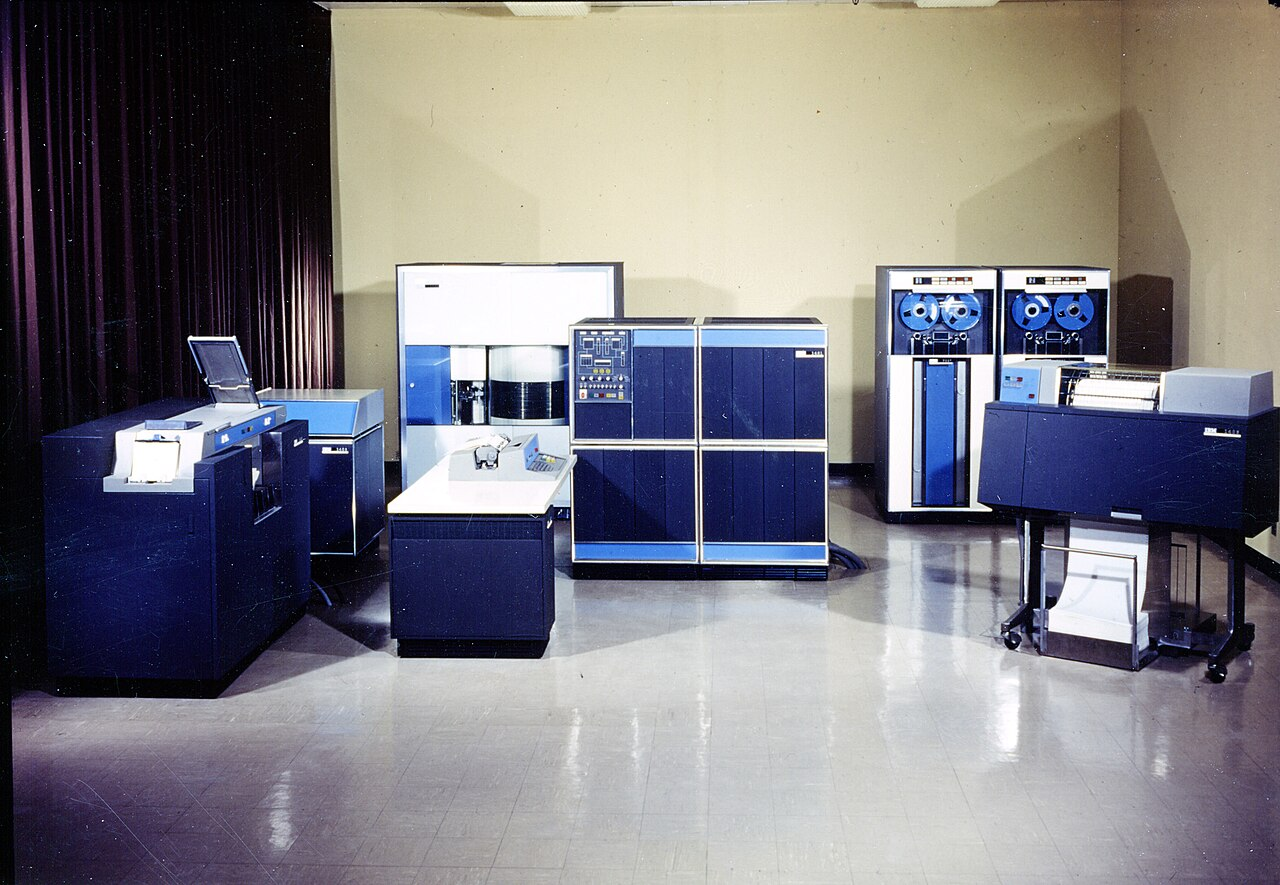
To choose a name, Coca-Cola reached for an unlikely tool for 1963: an IBM 1401 mainframe. The team asked the machine to generate four-letter words built around a single vowel, then mixed in suggestions from staff. Out of more than 185,000 possibilities, they cut anything awkward to pronounce or too close to a name already on the market.1

That narrowed things to roughly twenty contenders. The pick was “Tabb”, a wink at the idea of keeping tabs on your weight, and the spelling was trimmed to “Tab” before it ever reached a shelf.1

Myth check

You may have heard that TaB stands for “Totally Artificial Beverage.” It’s a fun rumor, and a complete fabrication. The name was a computer-generated coinage, not an acronym; the “artificial beverage” story has been debunked by both fans and Coca-Cola.2

The look

The capital-lowercase-capital that became iconic.

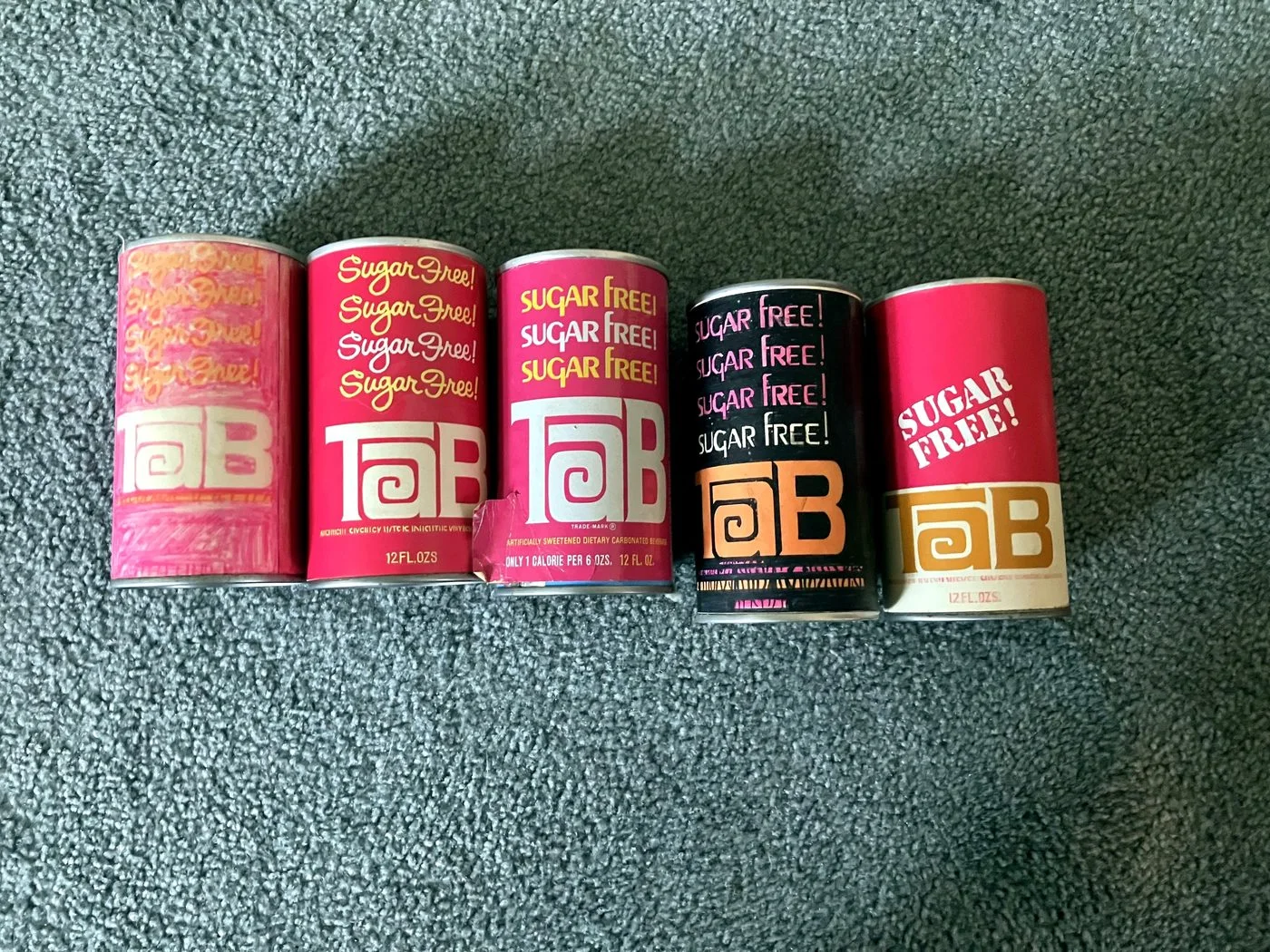
The unmistakable TaB wordmark, capital T, lowercase a, capital B, was the work of packaging designer Robert Sidney “Sid” Dickens.

Dickens is the one who locked in that off-kilter capitalization for the logo and drew a fresh bottle shape for the drink.1 That logo, paired with the bold pink can that arrived in the 1970s, gave TaB one of the most recognizable identities in soda history, a futuristic, confident look that stood deliberately apart from the red-and-white of Coca-Cola itself.

Across the decades the branding was refined but never reinvented: minimalist modernism in the ’60s, the bright “pink pioneer” era of the ’70s, and a string of subtle updates after. Collectors now chase the striped cans, the metallic-pink variants, and the limited regional designs, a timeline of American graphic design rendered in aluminum.

The iconic bright pink TaB can
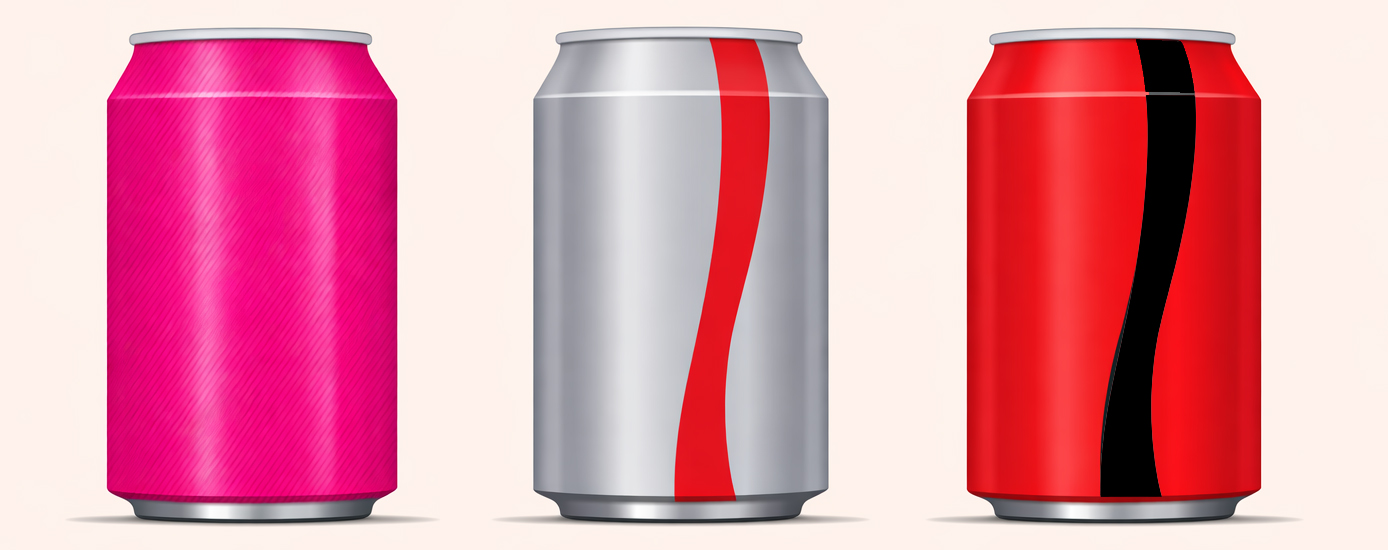
That unmistakable pink can. For millions of fans, it is the first thing they picture when they hear the word TaB.
The formula

Reformulated as the science changed.

TaB’s recipe was rewritten several times across its life, each change driven by the sweetener science (and regulation) of its era.

  1. 1963

    Cyclamate + saccharin

    TaB launched on a two-sweetener recipe, cyclamate working alongside saccharin. The cyclamate took the metallic edge off the saccharin, leaving the crisp, faintly tart taste fans remember.3

  2. 1969

    Saccharin only

    When U.S. regulators pulled cyclamate from the market in 1969, Coca-Cola rebuilt the recipe around saccharin on its own.3

  3. 1970s

    The saccharin scare

    In the early 1970s, studies on lab rats tied heavy saccharin intake to bladder cancer, and Congress responded by requiring a warning label on anything containing it, TaB included. The worry never held up in humans: the FDA gave saccharin a clean bill in 2000, and the EPA struck it from its hazardous-substances list in 2010.1

  4. 1984

    NutraSweet arrives

    In May 1984 Coca-Cola folded aspartame, sold as NutraSweet, into the blend alongside saccharin. It rounded out the sweetness, but plenty of longtime drinkers missed the sharper saccharin “bite” and never made peace with it.3

The taste

Crisp, clean, and impossible to copy.

Ask a TaB drinker what it tasted like and the answers are remarkably consistent.

  • “Crisp and clean.”
  • “Not too sweet.”
  • “A little citrusy.”
  • “A bite that Diet Coke never had.”

That last point matters. To the faithful, TaB and Diet Coke were never interchangeable. Diet Coke was built from a different flavor base, rounder, sweeter, more vanilla-forward. TaB was lean, bright, and sharp. People didn’t drink TaB because they couldn’t find Diet Coke; they drank it because nothing else tasted like it.

The TaB family

More than one pink can.

At the height of its popularity, the TaB name stretched across a whole lineup of sugar-free flavors, and, later, a few experiments that shared the name but little else.

1970s

Six sugar-free flavors

Beyond the cola, Coca-Cola offered TaB in Root Beer, Lemon-Lime, Ginger Ale, Black Cherry, Strawberry, and Orange, all diet.1

1983 · 1992

Caffeine-Free & Tab Clear

A caffeine-free TaB appeared in 1983, the same year Coke and Diet Coke went caffeine-free. Nearly a decade on, Tab Clear (1992) rode the short-lived craze for see-through colas.1

2006

TaB Energy

A TaB-branded energy drink turned up in 2006. It borrowed the name and the pink, but it was its own creature, a tart, sucralose-sweetened pick-me-up rather than the cola people loved.1

The ’70s & ’80s

TaB’s moment in the sun.

As diet culture and health-consciousness surged through the 1970s, TaB was perfectly placed, and its bright pink can, minimalist type, and confident attitude made it instantly recognizable.

It became a fixture of offices, gyms, and home refrigerators; a shorthand for independence and self-expression; a favorite of celebrities and everyday loyalists alike. The advertising leaned into empowerment and style, TaB wasn’t trying to be Coke, and that was the point.

The numbers backed up the image: even as competition multiplied, TaB was the best-selling diet soda in the United States in 1982.3

1982 · The turning point

Then Diet Coke arrived.

In 1982, Coca-Cola launched Diet Coke, a different drink that, crucially, carried the company’s own flagship name.

Coke believed Diet Coke was the brand to carry it into the future and battle Diet Pepsi, and it shifted its marketing muscle accordingly. For decades TaB and Diet Coke sat side by side on shelves, but the advertising dollars, and the attention, flowed to the newer brand. By many fans’ accounts, TaB went essentially un-advertised from 1982 onward.2

Slowly, TaB grew harder to find, surviving in scattered pockets of the country rather than on every shelf.

A collector's wall of vintage illuminated TaB signs, clocks, and neon
A collector’s shrine of vintage TaB signage. Long after the ads stopped, the devotion didn’t.
The long fade

A shrinking footprint, and a global one.

The slide was slow but steady. By 2011 the company was turning out only about 3 million cases of TaB a year, while Diet Coke moved somewhere near 885 million. By 2019, TaB accounted for roughly one percent of Coca-Cola’s cola business.5

Yet TaB was never just an American habit. At one time or another it poured in Canada, Spain, Norway (where it went by Tab X-Tra), the U.S. Virgin Islands, and the nations of the Southern African Customs Union; Australians drank it from the 1960s into the ’80s, and it reached British shelves from the late 1970s through the mid-1990s.1

The hunt

Harder to find never meant forgotten.

As TaB grew scarce, its fans grew resourceful.

They drove across state lines, called stores weekly, shared sightings online, bought cases for friends, and stockpiled whenever they found it. Entire websites and forums sprang up for the sole purpose of tracking down where TaB was still in stock, and channels appeared to ship it when local shelves ran dry.

It was a grassroots distribution network built on pure loyalty. The community kept the one-of-a-kind cola alive long after Coca-Cola’s marketing budget had moved on.

October 16, 2020

Coca-Cola announces the end.

On October 16, 2020, Coca-Cola announced it would stop making TaB by year’s end, part of a pandemic-era housecleaning meant to trim slower sellers and put its weight behind a tighter set of brands.4

It wasn’t the only casualty that day, the same announcement waved goodbye to Coca-Cola Life, Delaware Punch, Diet Coke Feisty Cherry, and Northern Neck Ginger Ale, among others. The last TaB rolled off the line on December 31, 2020, ending a 57-year run.4

The company’s reasoning was volume: TaB simply didn’t sell at the scale Coca-Cola wanted from a brand it kept in production. Rather than try to grow those numbers, Coke chose to retire it and focus on its core lineup and newer launches like Coca-Cola Zero Sugar.

For thousands of drinkers, though, it wasn’t a portfolio decision. It was the end of a 57-year relationship, and the beginning of an organized fight to reverse it.

After 2020

Where TaB lives now.

The iconic bright pink TaB can

Production has ended, and you can no longer buy TaB in a can or a bottle anywhere.

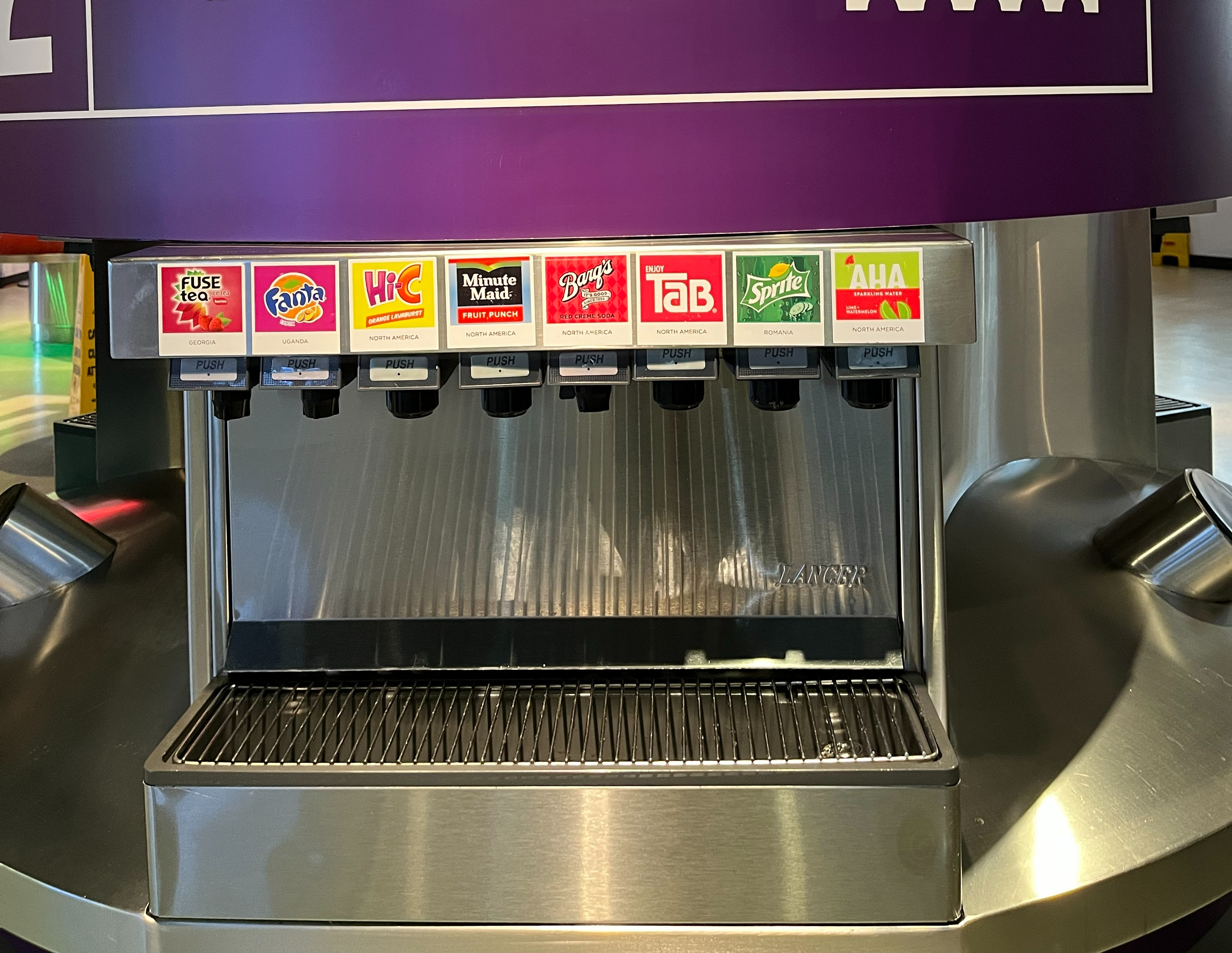
Today, fresh TaB survives in exactly one form: on fountain, at three Coca-Cola owned retail stores. You can still order a cup at the World of Coca-Cola in Atlanta, the Coca-Cola Store in Las Vegas, and the Coca-Cola Store at Disney Springs in Florida. Supply comes and goes, so always call ahead to be sure it is pouring before you make the trip.

Everywhere else, TaB lives in personal collections: unopened cans tucked into the refrigerators and pantries of devoted fans across the country, saved like treasure. And, of course, it lives on in our memories.

The comeback

The movement to bring TaB back.

Within weeks of the 2020 announcement, the grief turned into organization. In early 2021, fans founded the SaveTaBSoda Committee.1

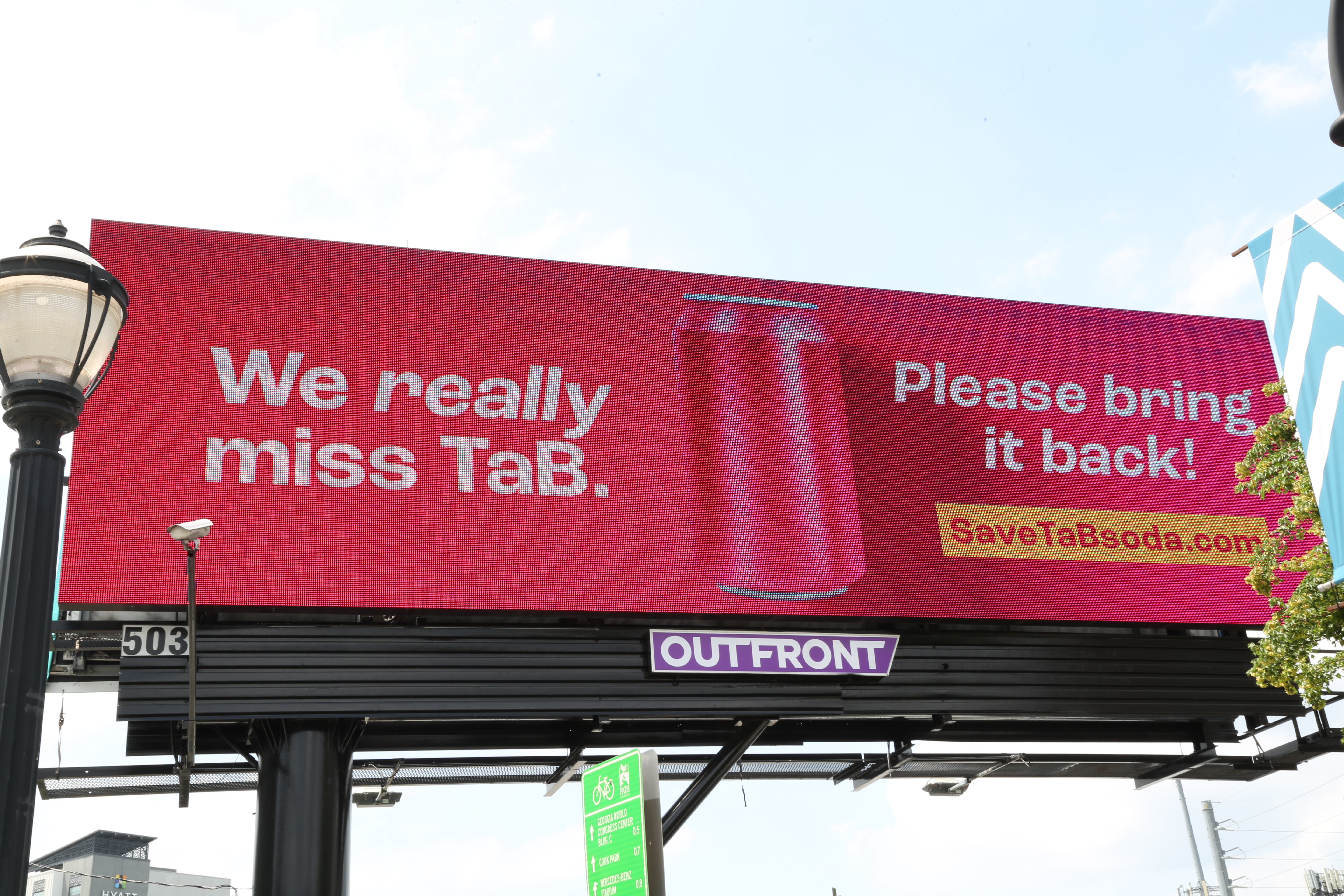
Since then, the committee has gathered thousands of petition signatures, run coordinated call-in days to Coca-Cola, raised billboards in Coke’s hometown of Atlanta, and delivered handwritten birthday cards straight to headquarters, even sponsoring a pink racecar to keep TaB in the public eye.

It’s a single, coordinated voice for a coast-to-coast community: this beloved, one-of-a-kind cola deserves to come back. Read the committee’s full story →

Why it matters

The diet cola that wrote the recipe everyone else followed.

TaB’s legacy is bigger than one discontinued soda. It proved that a diet cola could carry the Coca-Cola name and succeed, the very idea that made Diet Coke, and later Coca-Cola Zero Sugar, possible.

It also represents something harder to put on a balance sheet: loyalty, identity, nostalgia, community, a flavor profile no modern cola has matched, and a base of demand that never fully went away. The campaign to revive TaB isn’t about resisting change, it’s about honoring a product that earned its place in American culture.

In their own words

Why fans won’t let go

Real stories sent to us by TaB drinkers across the country, shared with their first names and lightly edited for length. Scroll through a few.

Have a TaB story of your own? Share it with us →

But the story isn’t over
“The power to revive TaB rests with us.”

The best way to help is the simplest: sign the petition, make some noise, and show Coca-Cola just how many of us still want this one-of-a-kind cola back.

Sign the petition More ways to help

Sources & further reading

Where these facts come from.

This page is an original summary compiled by the SaveTaBSoda Committee from public reporting and reference works. Key facts are footnoted below.

  1. “Tab (drink),” Wikipedia — naming origins, the flavor lineup, international markets, and assorted dates. en.wikipedia.org/wiki/Tab_(drink)
  2. “The History of TaB and Why It Was Discontinued,” The Daily Meal (2024) — Project Alpha, the “one calorie” campaign, the naming computer, and the post-1982 advertising freeze. thedailymeal.com
  3. Jeffrey Miller, “The rise and fall of Tab,” The Conversation (Nov. 2020) — the sweetener history (cyclamate, saccharin, NutraSweet), bottler resistance, and TaB’s run as the best-selling diet cola of the 1970s–80s. theconversation.com
  4. “Coca-Cola to stop selling Tab and other products,” TODAY (Oct. 16, 2020) — the discontinuation announcement, the other retired brands, and TaB’s decline after Diet Coke’s 1982 launch. today.com
  5. Beverage Digest, via “Cult Sodas With a History: Tab,” Fortune / CNN Money (2009) — TaB’s small-but-devoted following and the roughly 3 million cases a year it still sold in its later life. money.cnn.com

Spotted an error or have a primary source, photo, or memory to add? Tell us, we want this to be the most accurate TaB history anywhere.

← Back to the TaB timeline